
Truth To Power: 1991 Unreleased Interview with Ice Cube and Angela Davis
Angela Davis, a political activist, educator, and a black panther icon, sat down with Cube in 1991 to discuss race, politics, rap, and more. A meeting which resulted in a 2-hour conversation that was persevered by Indiana University Press and W.E.B. Du Bois institute. As seen on Shadow & Act, a snippet of the interview was film for Rap City and happened because Cube’s publicist Leyla Turkkan hoped that the interview would “position Ice Cube as an inheritor of the Black radical tradition” (Turkkan). As cited from Jerry Chang’s book “Can’t Stop Won’t Stop: A History of the Hip-Hop Generation”.
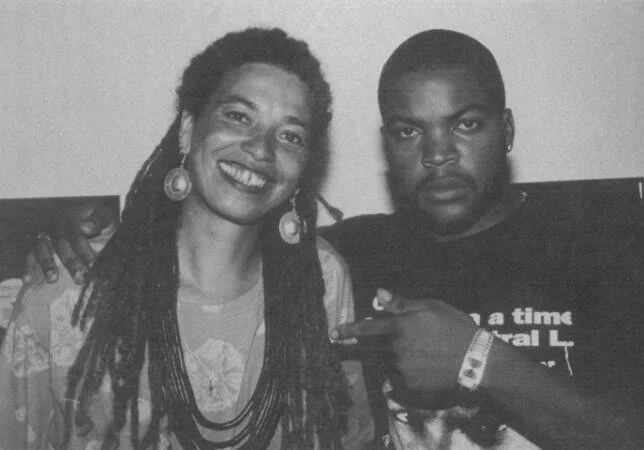
A Hip-Hop historian Jeff Chang, who thinks this meeting took place in July of ’91, writes in “Can’t Stop Won’t Stop.” The interview was a provocative idea—one that both Davis and Cube welcomed. But none of them had any idea how the conversation would turn when they got together in Cube’s Street Knowledge business offices. Cube sat back behind his glass desk in a black leather chair; the walls covered with framed gold records and posters “Boyz N Tha Hood” and his albums. Copies of URB, The Source and The Final Call were laid out in front of him. Davis started to ask Cube how he felt about the older generation. “When I look at older people, I don’t think they feel that they can learn from the younger generation. I try and tell my mother things that she doesn’t want to hear sometimes” (Cube).
During the extended interview, Davis asks Cube his thoughts on everything from party politics, his usage of the word “Bitch,” and Malcolm X. But in the filmed portion of the interview, the focus is-on the transition from his debut to his follow-up, beginning with Davis asking Cube, “Why do you think young sisters and brothers are so drawn to your voice, your rap, your message?” (Davis). “It’s the truth” (Cube). He provides that listeners find refreshing. “We got a lot of brothers who talk to a lot of people. But they ain’t saying nothing,” Cube argues. Calling himself someone “Who won’t sell out,” he goes on to answer Davis next question, “What’s the difference when you tried to do Amerikkkas Most Wanted and on Death Certificate?” In Cube response, “blind to the facts,” on the former, calling Death Certificate a“Step Forward, I know a few things, but I didn’t know now. I’ve grown as a person. When I grow as a person, I grow as an artist,” Cube continues, “I think I have more knowledge of self. I am a little wiser than I was. Amerikkkas Most Wanted, even though it was a good album-it was one of the best albums of the year. I was going through a lot of pressure personally. With this new album, Death Certificate, I can look at everything, without any personal problems getting in the way. It’s all about the music.”
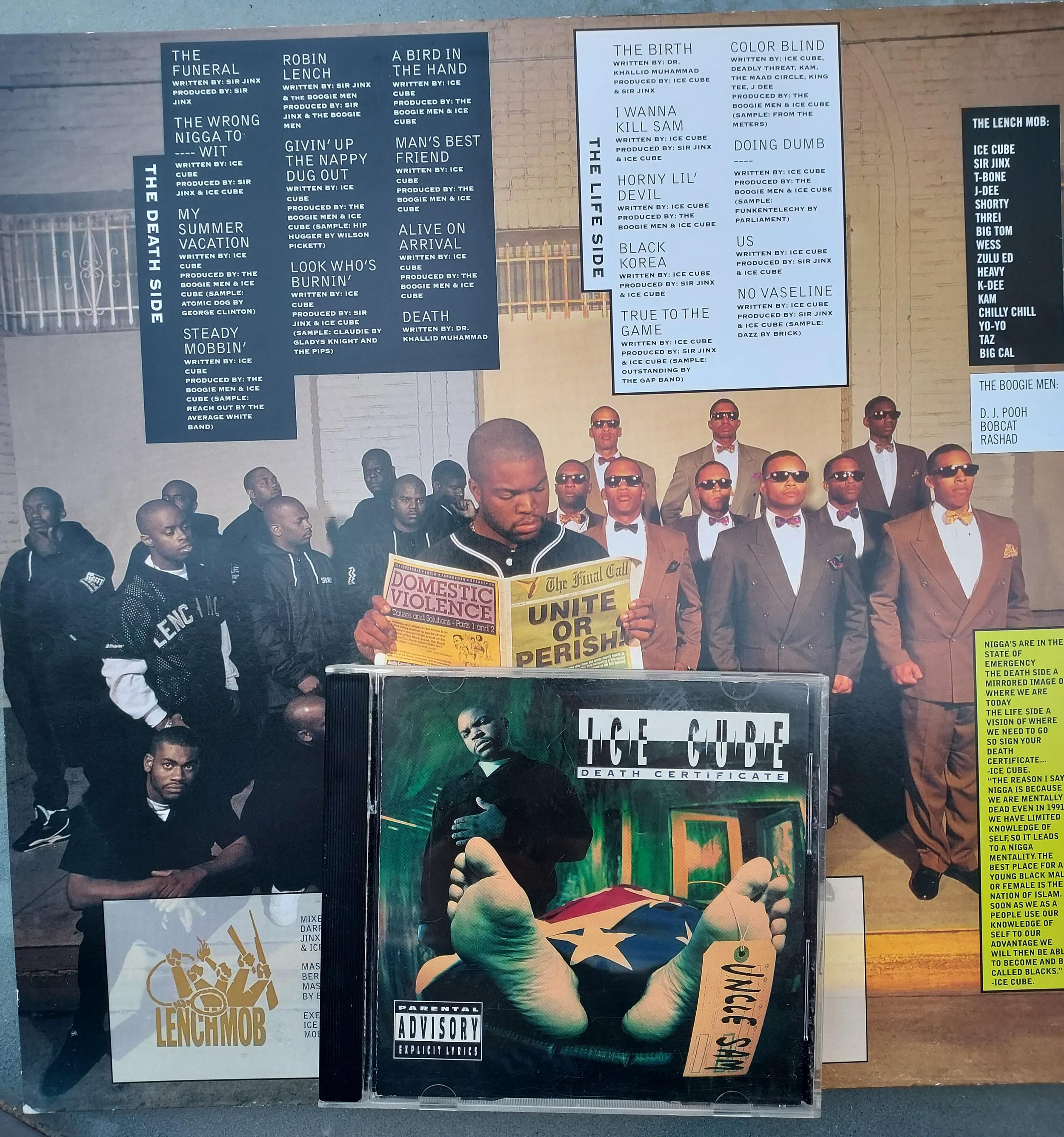
Ice Cube 2nd studio album, “Death Certificate”, distributed by Priority Records.
Davis asks Cube to explain the thought process behind the double-disc albums Side A (The Death Side) and Side B (The Life Side). Cube explains that “Most people liken it to gangster rap, reality rap is what it is. Side A starts off with a funeral because black people are mentally dead. It’s all about getting that across in the music. A lot of people like the first side. It’s got all that you would expect. At the end of the first side, The Death Side, I explain that people like the first side because we’re mentally dead. That’s what we want to hear now. We don’t love ourselves, so that’s the type of music we want to hear. Side B, which is The Life Side, starts off with birth and is about a consciousness of where we need to be, how we need to look at other people, how we need to look at ourselves and reevaluate ourselves” (Cube).
Davis asked Cube to comment on language, specifically “the efforts over the years to transform the language we use to refer to ourselves as Black people and specifically as Black Women” (Davis). She refers to the decline in use of the word “Negro” in American vernacular, and how it was, to her and many others, synonymous with the word '“Slave.” She asks Cube his thoughts on the use of the N-word in Rap lyrics, as well as the word “Bitch.” In response, he says “The language of the streets is the only language I can use to communicate with the streets,” adding, “We have to talk the language of the streets, tell the kids about the situation, tell them what’s really going on. Because some kids are blind to what they are doing to their own actions” (Cube). He also says, “It’s all an evolution process…But once we start working them up, opening their eyes, then we can start putting something in there. If you start putting something in there while their eyes are closed, that ain’t no good” (Cube).
Near the end of their conversation, Davis asks another question that would foreshadow the place in Hip-Hop has taken academics, with organizations from Howard University to the library of congress, recognizing Hip-Hops status in American History. “So, what do you have to say about the way Hip-Hop culture is now being examined and analyzed in the context of university studies?” (Davis). “Rap music is a school system itself, and one of the best schools' systems that we have. It’s entertainment, but it’s also a school system. Right now, we are more unified on a surface then we have been” (Cube).
To begin with, Davis only heard a few tracks from the still unfinished album “Death Certificate,” including “My Summer Vacation,” “Us” and a track called “Lord Have Mercy,” which never made it to the album but decided to add it on Da Lench Mob album “Guerillas in Tha Mist.” She did not hear the song that would become most controversial rap entitled “Black Korea.” In another way, Davis was at a more fundamental disadvantage in the conversation. Like Davis, Cube’s mother had grown up in the South; after moving to Watts and she had come of age as a participant in the 1965 riots. While Cube and his mother were close, they often argued about politics and his lyrics. Now it was like Cube was sitting down to talk with his mother. Davis was at a loss the way any parent is with her child, at the moment he is in the fullest agitation of his becoming.
